Celebration HOA Fees, CDD Assessments and the Resale Fee, Explained
Celebration has an owners association, a community development district, service areas, condo associations and a one-time fee at closing. Here is which one bills you for what
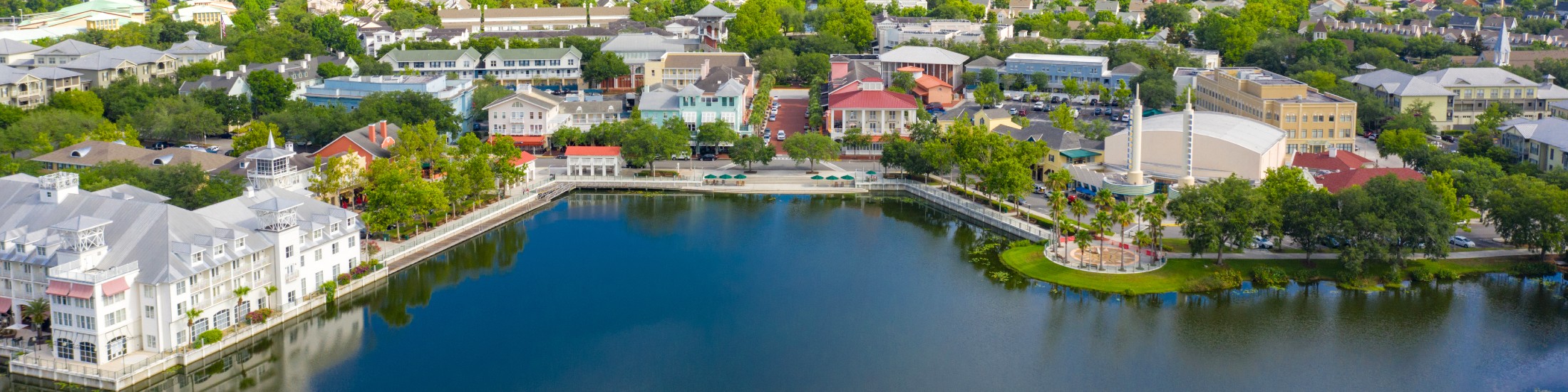
Celebration is an unincorporated master-planned community in Osceola County, so owners pay county property taxes but no city tax. Every residential owner belongs to the Celebration Residential Owners Association (CROA) and pays its base assessment; some townhomes add a service area assessment for roofs, exterior paint, landscaping and irrigation, and condominiums have their own associations. The Celebration Community Development District (CDD) maintains the downtown lake and esplanade, street trees, trails, alleys, street lighting and stormwater ponds, and its assessments appear on the Osceola County tax bill each November. CROA also collects a one-time capital contribution from each new owner at closing; a 2024 charter amendment proposed setting it at the greater of one year of base dues or 0.5 percent of the sale price.
Ask "what are the HOA fees in Celebration?" and the honest answer is a question back: which house, and which part of town? Celebration doesn't have one fee. It has layers, run by different organizations and billed on different schedules.
None of this is unusual for a Florida master-planned community. Celebration just has more pieces than most, partly because it's been around since the 1990s and has bonds that have already been paid off in some villages and not in others. Here is how the pieces fit, so the numbers on a disclosure make sense when you see them.
Is Celebration a City?
No. Celebration is an unincorporated master-planned community in Osceola County. There's no mayor, no city council and no city property tax. County government handles the services a city would, and the community-level work is split between an owners association and a special district.
That shapes the tax bill. The Florida Department of Revenue lists Osceola County's 2025-26 countywide millage at 6.7000 mills and its EMS Fire/Rescue levy at 1.0682 mills, plus school district taxes. On top of that comes the CDD line, covered below. For how Florida's homestead exemption and the Save Our Homes cap work on that bill, see our property tax and homestead guide. If you're still deciding between counties, our four-county comparison puts Osceola next to Orange, Seminole and Lake.
What Is CROA and Who Has to Pay It?
Every residential owner. The Celebration Residential Owners Association, Inc. is a Florida community association that operates under its recorded Community Charter and Chapter 720 of the Florida Statutes, the state's homeowners' association law. Owning a lot or unit makes you a member automatically, and members are required to pay assessments. If they don't, CROA can file a lien and foreclose on it.
CROA's base assessment is the community-wide dues every residential owner pays. CROA does not post the current amount on its public pages. Its own 2024 ballot materials, though, used an example that puts one year of base dues at $1,302.08 that year. Treat that as a 2024 reference point, not a 2026 quote; the current figure comes from the association's estoppel certificate during a sale or from CROA directly at 407-566-1200.
CROA sits alongside a few related bodies named on the community's governance site: the Celebration Nonresidential Owners Association (CNOA) for commercial property, the Celebration Joint Committee and Celebration Community Services. Residential buyers mostly deal with CROA. For the full contact list, see our comprehensive Celebration community contacts guide.
What Is a Celebration Service Area?
A service area is a group of townhomes that get extra exterior services and pay an extra assessment for them on top of base dues. CROA lists the services as roofing, exterior cleaning and painting, landscaping, irrigation outside gated sections, exterior caulking of windows and doors, shutters and exterior termite control.
The governing documents list service areas for townhome, bungalow and triplex groups in East Village, North Village, South Village, Artisan Park and Island Village, among others. Owners in townhome, duplex and triplex service areas must also carry fire and extended coverage on the unit at full replacement cost and name CROA as an additional insured. If the coverage lapses, CROA may buy it and bill the owner as a specific assessment. That's worth a call to your insurance agent before closing, not after. Our Florida homeowners insurance guide covers the rest of that conversation.
What About Condos in Celebration?
Condo owners pay a condominium association too, in addition to CROA. Celebration's governing documents list separate condominium associations for buildings including Artisan Club, Carlyle Residences, Carlyle Residences South, Mirasol, Siena, Spring Park Terraces, The Terraces, Terraces at East Village, Town Center and Waterstreet.
Condo associations in Florida carry their own budgets, reserves and insurance, and those numbers move independently of CROA. On a condo, ask for both estoppel figures, the current condo budget and the most recent reserve study before you commit.
What Does the Celebration CDD Pay For?
The public infrastructure you walk past every day. The Celebration Community Development District is a special-purpose local government created under Chapter 190 of the Florida Statutes. It maintains the downtown lake and esplanade, common-area landscaping and street trees in its right-of-way, sidewalks, boardwalks and trails, alleys, street lighting, fences and signs, stormwater ponds and drainage, and mosquito and aquatic weed control. It also hires off-duty deputies to supplement security.
The CDD is run by an elected Board of Supervisors, which moved to general elections in 2004 and generally meets the third Tuesday of the month at 6 p.m. Its fiscal year runs October 1 to September 30. A second district, the Enterprise Community Development District, also operates in Celebration and shares the 313 Campus Street district office.
How Do CDD Assessments Show Up on Your Bill?
On the Osceola County property tax bill, as a non-ad valorem line item, in November. They're collected the same way as property taxes, so if your taxes are escrowed, your lender pays the CDD line too. Nothing arrives as a separate monthly invoice.
The assessment has two parts. Debt service repays the bonds that built a village's infrastructure; it's fixed for the term of the bonds, based on each parcel's benefit, and can be paid down early in part or in full. If you sell before the bonds are paid off, the next owner takes over the remaining share. Operations and maintenance is set every year at a public budget hearing and moves with the district's actual costs.
Here's the Celebration wrinkle: because the community was built in phases, some owners now pay only the maintenance portion because their village's earlier bonds are already retired, while others still carry debt service. The CDD publishes a table of debt and maintenance assessments by village and product type at the end of each fiscal year's adopted budget. Two homes a few streets apart can have different CDD lines for that reason alone. For how CDDs work across the region, see CDD fees in Central Florida and the basics in What's a CDD?
What Is the Celebration Resale Fee?
A one-time capital contribution that CROA collects from each new owner when title transfers. It is separate from, and in addition to, the base and service area assessments, and it is not a prepayment of either.
For years it was one year of base assessment. In late 2024, owners voted on a charter amendment that proposed changing it to the greater of one year's base assessment or 0.5 percent of the gross sale price, with no cap. CROA's own examples: on a $400,000 home the contribution would be $2,000, and on a $1,000,000 home, $5,000. On a $200,000 home, one year of dues ($1,302.08 in that example) is still the larger number. CROA's governing documents page now lists the executed resale assessment amendment, dated December 31, 2024.
The board's stated reason was to fund repairs to aging amenities without raising annual dues for everyone. Its ballot materials said sales-based capital contributions brought in about $450,000 a year before the change. The amendment text includes a short list of exemptions, so confirm the exact amount with the title company on your contract.
Who pays it in practice is a contract question. The charter puts it on the owner taking title, which is the buyer, though buyers and sellers can negotiate who covers closing costs. Build it into your cash-to-close estimate either way.
So What Will You Actually Pay?
For a single-family home, plan on three recurring lines and one one-time line: Osceola County property taxes, the CDD assessment on that same tax bill, the CROA base assessment, and the capital contribution at closing. A service-area townhome adds a service area assessment. A condo adds a condominium association.
The way to get real numbers is document by document. Pull the current tax bill for the parcel from the Osceola County tax records, which shows the CDD line. Ask for CROA's estoppel certificate, which shows base and any service area dues plus the capital contribution. On a condo, get the condo association's estoppel and budget. Those three pieces of paper beat any average posted online, including ours.
What Works
- The CDD maintains the downtown lake, trails, street trees and lighting that make the town look the way it does, and its budget is set in public hearings.
- CDD assessments ride on the tax bill and can be escrowed, so there's no separate bill to forget.
- Some villages have retired their CDD bonds and now pay only maintenance.
- Service-area townhomes have roofs, exterior paint and landscaping handled by the association.
What to Know Going In
- There is no single Celebration fee. The total depends on the village, the product type and whether the CDD bonds on that parcel are paid off.
- The capital contribution at closing scales with price under the 2024 amendment and has no cap.
- Condo owners pay both a condo association and CROA.
- Service-area owners have insurance requirements that name CROA, and lapses get billed back.
- CROA does not publish current dues on its public site, so you'll need the estoppel or a direct call.
For the town's backstory, from Disney's plans to today, read the history of Celebration, and for what all these assessments actually maintain downtown, our downtown Celebration guide.
What Do the Neighbors Already Know?
They know the CDD line lands in November, that the lake and the trails are on that bill, and that the village matters more than the zip code. They also know the closing fee changed in 2024, because they voted on it.
New buyers usually find out from the closing disclosure. Better to find out now. For CDD meeting dates, adopted budgets and the assessment tables by village, go to the Celebration Community Development District. For CROA's governing documents and the charter amendment, see Celebration's governing documents page.
Want the real numbers on a specific Celebration home before you make an offer? Call/Text David Myers at 407.801.3286, or browse Celebration homes for sale. And no — we are not going to blow up your phone. We have enough to do, and so do you.