Winter Garden Downtown Historic District: Walking the National Register Streets
26 buildings, 100 acres, two railroad ghosts, and West Orange County's most walkable downtown
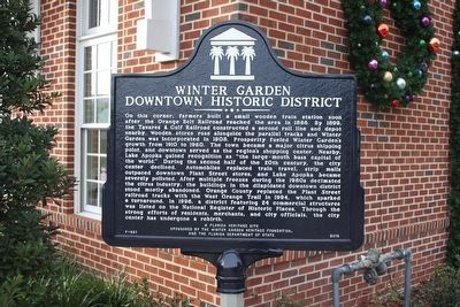
The Winter Garden Downtown Historic District is a U.S. historic district in Winter Garden, Florida, listed on the National Register of Historic Places on August 1, 1996 (NRIS #96000850). It encompasses approximately 100 acres bounded by Woodland, Tremaine, Henderson, and Lakeview Streets, and contains 26 contributing commercial buildings. The oldest documented structures are the Dillard and Boyd Building and 36 W. Plant Street, both dating to 1912. The district sits roughly 14 miles west of downtown Orlando, with the West Orange Trail running through it along Plant Street where two railroad lines once operated. A separate Historic Downtown Architectural Overlay adopted by the City in 2010 covers approximately 116 acres and 270 properties, providing design standards for renovations within the broader district.
Most Central Florida downtowns are a parking lot wearing a Main Street costume. Winter Garden's isn't. You can park once, walk the National Register block, watch a play in a 1935 movie palace, ride a 22-mile rail-trail in either direction, and never get back in your car. That's the result of a 30-year preservation push that started when downtown was mostly abandoned storefronts.
The Two Railroads That Built the Town
Plant Street looks the way it does because two railroads ran down the middle of it. The Orange Belt Railroad reached Winter Garden in 1886; the Tavares & Gulf Railroad laid a parallel line in 1899. By 1920 the town had passed 1,000 residents on the strength of citrus shipping and bass-fishing tourism out of Lake Apopka. Two separate fires destroyed the original wooden buildings — which is why the surviving district is brick.
What's Actually on the National Register
The City uses two overlapping but distinct definitions of "the historic district":
- The National Register district (1996): 26 contributing commercial buildings on approximately 100 acres, bounded by Woodland, Tremaine, Henderson, and Lakeview Streets. NRIS #96000850.
- The Historic Downtown Architectural Overlay (2010): a larger City-administered preservation zone covering roughly 116 acres and 270 properties, governed by an Architectural Review and Historic Preservation Board.
The Register listing gets the bronze plaques. The architectural overlay does the everyday work — it's why a homeowner two blocks off Plant Street can't slap vinyl siding over original wood lap. The 1995 survey identified two districts: the 26-building Commercial District (which got listed) and a 76-building Residential District. The broader historic Winter Garden you walk through is older and more intact than the headline number suggests.
Buildings to Walk Past, In Order
One hour, east to west from the Plant and Lakeview marker.
Garden Theatre on Plant — 160 W. Plant Street
The 1935 Mediterranean Revival movie palace with the Spanish-courtyard interior, "Romeo and Juliet" balconies, and dark-blue ceiling full of stars. It opened in December 1935 as the first Central Florida cinema built for sound pictures, closed in 1963, sat as a tractor warehouse for nearly 40 years, and was restored by the Winter Garden Heritage Foundation in 2008.
If you're researching from older articles: the nonprofit Garden Theatre, Inc. closed abruptly in October 2024 due to financial troubles. The City reopened the venue June 10, 2025 under the rebranded name Garden Theatre on Plant. The building is fine. The operating model changed.
Edgewater Hotel — 99 W. Plant Street
Built in 1927 as the tallest building on Plant Street, the Edgewater housed the trophy-bass anglers who came to fish Lake Apopka when it was billed as "the large-mouth bass capital of the world." When pollution killed the fishery, the hotel went dark. It's now operating again as a small boutique hotel.
Winter Garden Heritage Museum — 1 N. Main Street
Housed in a former 1918 train depot adjacent to the West Orange Trail. Free admission, Tuesday through Saturday. Permanent exhibits cover the railroads, the 1920 Ocoee Election Day Massacre (just east of here), and the citrus economy that funded most of the brick on Plant Street.
Plant Street Market & Crooked Can Brewing — 426 W. Plant Street
The newest anchor — already 10 years old as of May 2025. Opened May 2015 as a 12,000-square-foot indoor artisan market, with Crooked Can Brewing Company as cornerstone tenant and around 20 vendors alongside it. Not on the Register — it's new construction in the architectural overlay — but it's the single biggest reason the western end of Plant Street has the foot traffic it does today.
The Trail Is the Reason Any of This Survived
Downtown Winter Garden almost didn't make it. The 1980s freezes wiped out citrus. Lake Apopka's pollution collapsed bass tourism. Strip malls along West Colonial Drive drained downtown retail. By the early 1990s, Plant Street storefronts were mostly empty.
The turnaround was 1994, when Orange County tore up the Plant Street tracks and laid down the West Orange Trail. Converting that right-of-way to a 22-mile linear park brought people back. Register listing followed in 1996; Plant Street Market in 2015. The trail is now the spine of the district — Centennial Plaza, the linear park, and the rows of patio dining all organize around the corridor where the trains used to run.
The Saturday Farmers Market
Every Saturday year-round, 8:00 a.m. to 1:00 p.m., at the Downtown Pavilion at 104 S. Lakeview Avenue. More than 100 vendors, around 3,500 weekly visitors, and the American Farmland Trust has repeatedly named it the best farmers market in Florida. Live music runs roughly 9:00 a.m. to 1:00 p.m. The market launched in 2008 — same revival decade as the theatre's restoration.
Why This Matters If You're House-Hunting
The historic district itself is small and mostly commercial. The neighborhoods that surround it — where you'd actually buy — are a mix of original 1900–1940s residential streets (Tremaine, Boyd, Lakeview) and newer infill. Walkable-to-Plant-Street homes carry a noticeable price bump over equivalent square footage two miles out toward SR 429. For walkable-downtown lifestyle without historic-overlay constraints, our Horizon West and Ocoee guides cover adjacent communities a few miles south and east.
Practical Visitor Info
- Where to start: The Florida Historical Marker at Plant Street and Lakeview Avenue, erected 2015.
- Parking: Always free. Three-level garage at 160 S. Boyd Street, 117-space lot at 37 N. Boyd Street, plus street parking along Plant.
- Best day for full energy: Saturday, for the farmers market plus full downtown traffic. Quieter walk-through: Tuesday or Wednesday.
- From downtown Orlando: ~14 miles, 25–30 minutes via SR 408 west to SR 429 south.
- Trail access: The West Orange Trail runs directly through the district. Bike rentals available downtown.
What the Locals Know
Three things that don't make most write-ups. The brick streetscape is largely an accident of two fires — wooden originals burned, brick replacements survived. The National Register listing didn't save downtown; the rail-trail did, and the listing followed the recovery rather than leading it. And the architectural overlay doing the day-to-day preservation work has only been on the books since 2010.
If Plant Street doesn't feel like a Disney-fied "old Florida" theme set, that's why. It's a real downtown with a real recovery story — the Garden Theatre operator change in 2024–2025 is part of it, not an exception.
For building inventories, walking-tour resources, and current event programming, visit the Winter Garden Heritage Foundation, and for the City's overlay map and ordinance details, see the City of Winter Garden Historic District page.
Thinking about buying within walking distance of Plant Street, or in a West Orange County community just outside it? Browse Winter Garden homes for sale, our adjacent Ocoee and Horizon West guides, or contact us for a walk-through with a local agent.