Public Art and Community Design in MetroWest: How the Master Plan Shaped the Neighborhood's Look
From a Venetian horse fountain to landscape-as-architecture — the deliberate design choices behind Orlando's original master-planned community
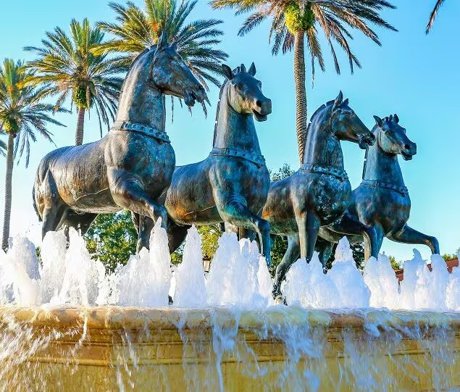
MetroWest is a 1,805-acre master-planned community in southwest Orlando, FL, developed beginning in 1985 by Debra, Inc. The community's signature piece of public art is the Quattro Cavalli statue fountain at Veranda Park, a bronze replica of the Four Horses of St. Mark's Basilica in Venice, cast by Italy's Valese Artistic Foundry. MetroWest's design language is governed by the MetroWest Master Association's Design Review Board, established February 17, 1986, which approves all architecture and landscape plans for the community. MetroWest won the City of Orlando's 2012 City Beautiful Award and the 2013 Florida Communities of Excellence Safety and Security Award.
Most master-planned communities in Central Florida show their hand the same way — gated entry, repeating elevations, a clubhouse, a fountain. MetroWest, sitting on 1,805 acres in southwest Orlando, was one of the first to do it at this scale, and the design choices baked into its 1985 master plan still shape what you see when you drive in today. The story comes down to three things: one genuinely distinctive piece of public art at the heart of the town center, a landscape philosophy the master association literally describes as treating plants "like fine architecture," and an architectural review board that's been quietly enforcing visual consistency since February 1986.
The Quattro Cavalli: MetroWest's One Truly Distinctive Public Artwork
If MetroWest has a signature image, it's the Quattro Cavalli statue fountain at Veranda Park, the mixed-use town center near the corner of South Hiawassee Road and Westpointe Boulevard.
Quattro Cavalli is Italian for "four horses," and these aren't generic decorative bronzes. They're a replica of the world-famous Four Horses of St. Mark's Basilica in Venice — one of the most storied pieces of public sculpture on earth, with a 1,700-year history that runs through Nero's Rome, Constantinople, Napoleon's Paris, and finally a permanent home above the doors of St. Mark's.
What makes MetroWest's set unusual: the bronzes were cast by Italy's Valese Artistic Foundry, the only foundry authorized by the Italian government to reproduce the ancient horses. When MetroWest's were installed they were described as the only such replica in the United States — no longer strictly true since Kentucky State University unveiled its own in August 2020, but MetroWest's remains one of only a handful of authorized replicas in the country, and almost certainly the only one anchoring a residential community.
Why a Venetian Reference at All?
Veranda Park itself was envisioned in 2005 by original developer Kevin Azzouz as a Mediterranean-styled, walkable town center. The 150-unit Residences at Veranda Park building, with its 48,000 square feet of ground-floor retail, leans hard into European vocabulary: tile roofs, ornamental ironwork, marble lobbies, arched openings. The Quattro Cavalli fountain isn't a one-off ornament — it's the visual anchor for an architectural argument: that a residential community in suburban Orlando can borrow from Venetian and Mediterranean templates without feeling like a theme-park backlot.
Landscape as Architecture: The Master Plan's Real Secret
Straight from the MetroWest Master Association's own description: "Landscaping was treated like fine architecture, carefully chosen and planted to grow into what many now describe as an oasis in a busy city. Islands of trees and flowering shrubbery separate traffic. Gentle curves were chosen over harsh corners."
Read that carefully. The mid-1980s plan didn't just specify setbacks and zoning — it specified that the roads themselves would feel less like suburban grid and more like a curated park. That's the move you feel driving in off Kirkman Road or down MetroWest Boulevard. None of the planted medians, curving streets, and layered canopy is accidental — it's design intent executed at the engineering stage, before a single house was built. It's also why MetroWest punches above its weight against newer comps in Horizon West or southwest Windermere — same housing stock, none of the streetscape.
The Design Review Board: The Reason Things Still Match
Master plans are easy to draft and notoriously easy to abandon once a developer moves on. MetroWest's hasn't been, and the reason is structural: the MetroWest Master Association, established February 17, 1986, runs a standing Design Review Board (DRB) that approves all construction and design plans across the community's common areas and many of its subdivisions.
The DRB reviews architectural plans against published guidelines, enforces consistency with existing structures and topography, and oversees landscape changes in common areas — which is how the original "treat landscaping like architecture" intent survives 40 years later. MetroWest looks intentional from the boulevards but loosens up inside individual gated subdivisions, where HOAs like Palma Vista, The Hamptons at MetroWest, and Stonebridge Commons layer their own standards on top.
What Makes MetroWest Look Different From Newer Communities
If you've toured Dr. Phillips or newer Horizon West villages and then drive into MetroWest, a few things stand out:
Topography you can see. Most of West Orange County is flat. MetroWest isn't — Palma Vista sits at 198 feet above sea level, one of the highest points in Orange County, with downtown Orlando's skyline visible 5 miles east. The plan built around the elevation rather than flattening it.
An 18-hole Robert Trent Jones Sr. golf course as spine. The MetroWest Golf Club, opened in 1987, is woven through the community's geography rather than tacked on the side.
A real town center. Veranda Park is the mixed-use experiment most Orlando master-planned communities only paid lip service to: five stories, residential above retail, a public plaza with the Quattro Cavalli, and a Saturday farmers market with around 60 vendors.
1.5 miles of Turkey Lake frontage. The plan reserved the southeast edge for lake and golf, concentrating density on the 350-acre urban core south of MetroWest Boulevard — preserving water views for more residents than a typical lot-maximization layout would.
Where the Design Story Has Limits
Despite the master association's strong design oversight, this isn't a community packed with public art. You won't find the kind of distributed sculpture program in Baldwin Park or the curated portfolio at Lake Nona. MetroWest has one significant statement piece (the Quattro Cavalli), a few decorative entry markers, and the everyday effect of curated medians and architectural review — less art-as-attraction, more art-as-anchor. Some of the development still on the drawing boards from the original 1985 master plan never got built, and the community went through a contentious ownership dispute in the late 2000s before residents bought out then-controller Carl Shakarian in 2014.
Awards and Recognition
The City of Orlando and the State of Florida have publicly recognized the community several times:
- 2012: City of Orlando "City Beautiful Award" for District 6
- 2013: Statewide winner, Florida Communities of Excellence Safety and Security Award
- 2014: City of Orlando Environmental Excellence Award (reclaimed water use)
- 2014: Florida Communities of Excellence finalist, Florida Friendly Landscaping
- 2016: Florida Communities of Excellence finalist, Water Conservation
Where to See It
For the design story in a 30-minute drive: start at Veranda Park (corner of South Hiawassee Road and Westpointe Boulevard) for the Quattro Cavalli and Mediterranean town-center architecture, then drive west along Westpointe Boulevard and onto MetroWest Boulevard for the strongest streetscape. Cut through Palma Vista to see the elevation change and golf-frontage architecture. The Veranda Park Farmers Market runs every Saturday morning, which is when the town center is being used as designed.
What the Locals Know
MetroWest's design story is less "we built a sculpture park" and more "we made a hundred small choices in 1985 that still hold up." The Quattro Cavalli at Veranda Park is the marquee piece — an authorized Italian bronze replica of one of Western art's most famous public sculptures, sitting at the center of a Mediterranean-styled town center in suburban Orlando. But the real design legacy is the stuff you stop noticing once you live here: curved boulevards, planted medians, and an architectural review board approving everything down to facade colors for 40 years.
If you value visual consistency and one community-defining piece of public art over the aggressive amenity packages of newer developments, MetroWest was built for you. If you want a curated public art program with rotating installations, look downtown or at Lake Nona instead.
For more on the master association and design guidelines, visit the official MetroWest Community website. The Quattro Cavalli fountain is documented in United Arts of Central Florida's public art database.
Curious how MetroWest compares to other master-planned communities in the area? Browse listings in nearby Dr. Phillips, Windermere, and Downtown Orlando, or contact us for a side-by-side neighborhood comparison.