Big Tree Park: Where Central Florida's 3,500-Year-Old Giant Once Stood
Longwood's most famous tree is gone — but here's what still makes the boardwalk worth knowing about.
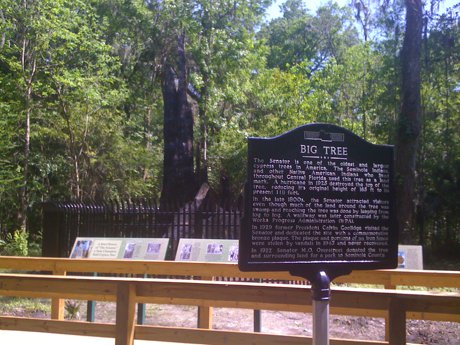
Big Tree Park is a free Seminole County park at 761 General Hutchison Parkway in Longwood, FL, about 30–40 minutes north of west Orange County. It was home to "The Senator," a roughly 3,500-year-old bald cypress that was the largest tree east of the Mississippi River until an arson fire destroyed it on January 16, 2012. The park still features "Lady Liberty," a roughly 2,000-year-old cypress about 89 feet tall, plus "The Phoenix," a clone of The Senator planted in 2013. Big Tree Park is open daily from 8 a.m. to dusk, has a short interpretive boardwalk, restrooms, and a playground, and serves as a trailhead for the Cross Seminole Trail.
Here's the thing most articles about Big Tree Park bury three paragraphs deep, and we'd rather just tell you up front: the big tree is gone. The Senator — a 3,500-year-old bald cypress that was, by most accounts, the largest tree east of the Mississippi River — burned down in 2012. So if you're picturing a drive out to stand beneath an ancient, towering giant, we need to recalibrate before you load up the car.
But stick with us, because the story behind this little Longwood park is genuinely one of the most remarkable (and heartbreaking) in Central Florida, and there's still a good reason to put it on your radar. Let's be real about what you'll find and whether the trip makes sense for you.
The Senator: The Tree That Made the Park
Long before Walt Disney World — before Orlando was anything but citrus groves and swamp — there was The Senator. Native American groups, including the Seminoles, used the enormous cypress as a regional landmark. By the late 1800s it was already pulling in curious visitors — back when reaching it meant hopping log to log across the swamp.
The numbers are almost hard to believe. At roughly 3,500 years old, The Senator was one of the oldest trees on the planet. It stood about 118 feet tall at the end (a 1925 hurricane had already knocked off a chunk of its original height, which may have topped 165 feet), with a trunk circumference around 35 feet. State senator M.O. Overstreet donated the tree and the surrounding land to Seminole County, and the site was formally dedicated in 1929 by former President Calvin Coolidge. That makes it one of the oldest tourist attractions in all of Central Florida — it was drawing crowds decades before the theme parks showed up.
What Actually Happened in 2012
On January 16, 2012, The Senator caught fire from the inside and collapsed. Investigators initially suspected lightning, but the truth turned out to be far more senseless: the fire was the result of arson. Someone had lit a fire inside the tree's hollow trunk, and a 3,500-year-old living monument — one that had survived hurricanes, lightning, and millennia of Florida summers — was lost in a matter of hours.
It's the kind of loss that still stings for longtime locals. Pieces of the original tree were salvaged, and sections of it are now preserved at the Museum of Seminole County History, where the charred wood has been turned into artwork so people can still stand close to a piece of the giant.
So What's Actually Left to See?
More than you'd guess, honestly. Seminole County rebuilt the site as a memorial park, and here's what's waiting at the end of the boardwalk:
- Lady Liberty — The Senator's companion cypress, and the real star now. She's a comparatively "youthful" 2,000 years old, stands around 89 feet tall, and is very much alive. She was likely a sapling around the time of the Roman Empire.
- The Phoenix — A genetic clone of The Senator, grown from 1990s cuttings and planted near the playground in 2013. Named by a county-wide elementary school contest, it's a literal second chance at the original tree (give it a few thousand years).
- The interpretive boardwalk — A renovated walkway with signage that winds through a hydric hammock swamp, the same old-Florida ecosystem the tree grew in.
- A cypress-stump playground piece — A nod to the tree, sized for kids.
The park also sits inside the larger Spring Hammock Preserve, one of Seminole County's most ecologically rich natural areas, and it serves as a trailhead for the paved Cross Seminole Trail. That combination is the key to enjoying this place — more on that in a second.
Visiting Big Tree Park: Hours, Directions & Tips
The practical details are refreshingly simple:
- Address: 761 General Hutchison Parkway, Longwood, FL 32750 (Seminole County, between US 17-92 and SR 427)
- Hours: Daily, 8 a.m. to dusk (gates lock at posted closing time)
- Cost: Free — no admission, no parking fee
- Amenities: Restrooms, picnic area, playground, paved parking
- The walk itself: A roughly 0.3-mile round-trip boardwalk — figure 15–30 minutes
Our honest local tip: don't drive out here expecting to fill an afternoon at the park alone. It's a quick, contemplative stop, not a sprawling destination. The move is to pair it with something else. Hop on the Cross Seminole Trail for a bike ride, then head a few minutes north to historic Downtown Sanford for lunch, or swing by Cranes Roost Park in nearby Altamonte Springs. If you're already making the trek to this side of the metro, our Mount Dora and Cassadaga day trip guide rounds out a full north-metro itinerary.
Should West Orange Homebuyers Care?
Let's address the geography honestly, because it matters. Big Tree Park is in Longwood, on the north side of the metro — a solid 30–40 minute drive from west Orange County communities like Windermere, Winter Garden, and Ocoee. This is not your neighborhood park. It's a "worth-the-drive-once" curiosity and a piece of regional history, not a daily-life amenity.
So if you're relocating to the west side and want big trees and boardwalks closer to home, you've got excellent options. The paved West Orange Trail runs right through Winter Garden, and the cypress-and-pine boardwalks at Tibet-Butler Preserve scratch a similar old-Florida itch just outside Windermere. For the full rundown of green space on that side of town, our Windermere parks and recreation guide is the place to start.
The Pros
- Free, easy, family-friendly, and genuinely historic
- Lady Liberty is a real, living 2,000-year-old tree — that's no small thing
- Doubles as a Cross Seminole Trail trailhead and Spring Hammock Preserve access point
- Quick stop you can fold into a bigger Sanford or Altamonte day
The Cons
- The headline attraction, The Senator, is gone — manage expectations
- Small footprint; the boardwalk is short and over quickly
- A real haul (30–40+ minutes) from Orlando's west and southwest communities
What the Neighbors Know
Locals will tell you Big Tree Park is a place you visit for the story as much as the scenery. There's something quietly moving about standing where a 3,500-year-old organism lived through the entirety of recorded human history, only to be lost to a careless act in our own lifetime. Lady Liberty standing watch nearby — and The Phoenix slowly rising from the same soil — gives the place a resilience that's hard to fake.
For relocators, the lesson is bigger than one park: Central Florida is layered with these old-Florida pockets, tucked between the highways and subdivisions, if you know where to look. Big Tree Park just happens to wear its history on its sleeve. Go once, read the signs, let it land, and then chase the rest of the region's natural gems closer to wherever you end up calling home. 🌳
For current hours, directions, and park details, visit the official Seminole County Big Tree Park page, and you can read more about the tree's legacy through local coverage from Spectrum News 13.
Thinking about where in Central Florida to put down roots? Explore homes and neighborhood guides for Winter Garden and Windermere, or contact us for personalized relocation advice from people who actually know the area.