Main Street Windermere: The History Behind the Town's Central Corridor
From a railroad platform and citrus warehouses to brick lanes, roundabouts, and a downtown that still feels like 1925
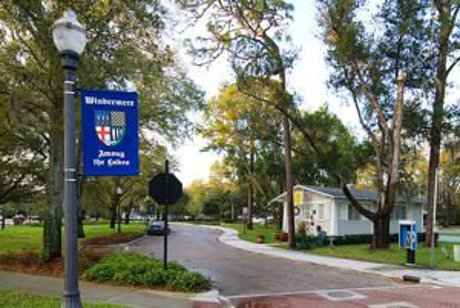
Main Street Windermere is the central north-south corridor through downtown Windermere, FL, platted in 1889 and still anchoring the 2.2-square-mile incorporated Town of Windermere. The street runs from the northern town line south to 12th Street, where pavement turns west onto Chase Road toward CR 535. Three buildings on the Main Street corridor are listed on the National Register of Historic Places: Windermere Town Hall at 520 Main Street, the Cal Palmer office building at 502 Main Street, and the 1890 Windermere Schoolhouse. Two roundabouts on the Main Street alignment were installed in 2004, with a third added in 2010, as part of a deliberate small-town traffic-calming program.
So you've heard about the celebrity homes and Tudor-cottage charm of Windermere — but all that polish sits on top of one of the oldest, most deliberately preserved street grids in Central Florida. Main Street is the spine, and the corridor has a lost railroad behind it, an 1889 town plat under it, and a set of roundabouts designed to keep cut-through traffic from steamrolling a 2.2-square-mile village. Let's walk it from the beginning.
The 1880s: An Englishman, 160 Acres, and a Lake That Reminded Him of Home
Before there was a Main Street, there was Stanley Scott — an Englishman who settled on 160 acres near Lake Butler in the mid-1880s and named the area after the largest lake in England's Lake District. Other settlers did the heavy lifting on what became downtown: in 1889, a town site was platted along a north-south alignment that traced the shortest dry-land crossing between Lake Butler, Lake Down, and Lake Bessie. That alignment became Main Street, and the grid laid down then is still legible today.
Why Main Street Sits Where It Does (Hint: Geography Did It)
The Town sits on a narrow isthmus between several lakes, so Main Street isn't there because someone picked a pretty spot — it's there because it was the only place a north-south road could go. The next dry-land crossing of the chain to the south is 7.5 miles away at Lake Buena Vista; the next crossing north is 2.25 miles away in Gotha.
That geography turned Main Street into a regional through-route long before anyone wanted it to be one. By the early 2000s, daily counts on Main Street north of Sixth Avenue were hitting roughly 18,000 vehicles a day, most of it cut-through commuters using the town as a shortcut. That number drives almost every traffic decision the town has made since.
The Lost Railroad Behind Main Street
One of the best-kept secrets of downtown Windermere is the ghost of the Florida Midland Railroad. From the early 1900s into the mid-20th century, a rail line ran just west of Main Street — close enough that the back doors of citrus warehouses opened onto loading platforms on the tracks. Citrus was the cargo, and the freeze-resistant high ground around the Butler Chain was the reason the line came through.
The railroad is gone. What's left is a wide, grassy strip between Main Street and a parallel sand road locals call "Dirt Main Street," running roughly from Third Avenue to Seventh Avenue. That strange linear green space behind the storefronts is a railroad right-of-way that quietly turned into a public commons.
1925: The Town Becomes a Town
Even though the plat was drawn in 1889, Windermere didn't formally incorporate until 1925. Three men from Ohio — Cal Palmer, J. Howard Johnson, and Howard Lyon — pushed through the charter, and John Jaquith served as the first mayor. The 100th anniversary of incorporation was celebrated across 2025 with centennial events on Main Street.
Two of the buildings the founders left behind still stand on Main Street, both on the National Register of Historic Places:
- Windermere Town Hall, 520 Main Street. The two-story wood-frame building started as the Woman's Club, built between 1922 and 1924 on the shore of Lake Butler. It was moved to its current Main Street site in 1938 and formally became Town Hall in 1945.
- Cal Palmer's office building, 502 Main Street. Built in 1911, one of the oldest surviving commercial structures in town. Palmer was the second mayor and a relentless civic donor.
- The 1890 Windermere Schoolhouse (Parramore House). Orange County's first one-room school, used as a schoolhouse until 1916 and later preserved as a museum-quality landmark.
Three nationally registered historic buildings inside a 2.2-square-mile town is a density of preserved civic history no other Butler Chain community can match. For more, see our tour of the 1890 Schoolhouse and our piece on 100 years of Windermere Town Hall.
The Brick-and-Dirt Streets Ordinance
Walk one block off Main Street in any direction and the pavement ends. That's not neglect — it's policy. The Town preserves unpaved sand streets and red-brick lanes across most of the historic core by deliberate ordinance. Main Street itself is paved because it's a through route, but the named avenues and numbered streets crossing it are the way they were a century ago. The unpaved-streets policy keeps the village aesthetic that buyers in Windermere Town, Magnolia Park, and Windermere Downs are paying for, while slowing traffic to a pace that makes side streets functionally walking-only on a busy weekend.
The 2004 Roundabouts: A Public Works Plot Twist
By the early 2000s, with Main Street carrying about 18,000 vehicles a day, the town's response in 2004 was the largest public works project in its history: two roundabouts on the Main Street corridor, designed to slow regional traffic to a residential pace and discourage shortcut use entirely. A third was added in 2010 at Park Avenue and Maguire Road near Windermere Elementary.
The result is what you experience today — a downtown where Main Street is a real street with crosswalks and parallel parking, not a four-lane highway pretending to be one. It's a big part of why the Main Street restaurants and cafes and the downtown shopping district still feel like a small town instead of a strip-mall corridor.
Town Square Today: Where Main Street Becomes a Living Room
The patch of green where Town Hall sits is what locals just call Town Square — the de facto living room of Windermere. The Friday-morning Windermere Farmers Market happens here, along with the monthly Food Truck Night, the annual Fine Art Show, and the trio of seasonal Main Street events — the Halloween Costume Parade, PetFest, and Light Up Windermere. None of those events happen in Dr. Phillips or the surrounding unincorporated 34786 ZIP code the same way. They happen here because there's a real downtown — with a real Main Street — to host them.
What the Locals Know
Main Street Windermere isn't really a road. It's a 130-year-old decision to keep a place small. Every choice that's been made on the corridor — the unpaved side streets, the moved Town Hall, the preserved schoolhouse, the roundabouts, the calendar of branded town events — has been a vote against turning downtown into something it isn't.
For buyers looking at homes in Windermere Town or anywhere walkable to Town Square, the practical implication is this: the Main Street corridor is unlikely to change much. The historic-register buildings can't be torn down. The brick streets won't be paved over. The roundabouts are doing what they were designed to do. What you see is roughly what you get for the next several decades — and for a lot of people, that's exactly the point.
For more on Windermere's downtown character, see our guides to arts and culture in Windermere and downtown events and entertainment.
For official town information, meeting agendas, and updates on the centennial preservation projects, visit the Town of Windermere website.
Thinking about a home near downtown Windermere or anywhere in the 34786 ZIP code? Browse Windermere homes for sale or contact us for personalized relocation advice — we know this corridor block by block.