Winter Park, Florida: The Story Behind Orlando's Most Storied Town
Brick streets, lakefront estates, Tiffany glass, and a price tag to match — here's what actually gives Winter Park its character
Winter Park is a city of nearly 30,000 residents in Orange County, Florida, located roughly six miles north of downtown Orlando. Founded as a winter resort for wealthy Northerners by Loring Chase and Oliver Chapman in the early 1880s and incorporated in 1887, it was deliberately designed with brick streets, a shady oak canopy, and a central park beside a chain of lakes. Winter Park is home to Rollins College (Florida's first four-year college, founded 1885) and the Charles Hosmer Morse Museum, which holds the world's most comprehensive collection of Louis Comfort Tiffany works. It is one of Central Florida's most expensive markets, with median sale prices in the high $400,000s to $600,000s and a prestige core near Park Avenue that routinely exceeds $1 million.
Most Central Florida towns grew up around something practical — a railroad junction, a citrus packing house, a highway interchange. Winter Park grew up around an idea. Two Northerners with money and taste sketched a town on paper, planted the oaks, curved the brick streets around the lakes, and sold it as a place beautiful enough to winter in. Nearly a century and a half later, that idea is still doing the heavy lifting.
So what gives Winter Park its character — the thing you feel within five minutes on Park Avenue but can't quite name? It's not one feature. It's the way the history, the lakes, the college, the art, and the money all stack on top of each other, trade-offs included.
How Winter Park Became Winter Park
The founding story in a nutshell: in the early 1880s, Loring Chase and Oliver Chapman bought roughly 600 acres for about $13,000 and laid out a planned community for affluent Northerners escaping the cold. The first railroad depot was finished in 1882, a real estate boom followed, and the town incorporated in 1887.
What matters today is that Winter Park was designed from the start. Chase and Chapman bent the streets around the lakes, set aside a town green (today's Central Park), and planted the oaks that now shade the district. In 1885 the Congregational church founded Rollins College — Florida's first four-year college — cementing the town's cultured, intellectual reputation. (President Chester A. Arthur reportedly called it "the prettiest place I have seen in Florida.") That built-for-beauty DNA is why it still feels different from a subdivision that went up last year.
Park Avenue: The Heart of It All
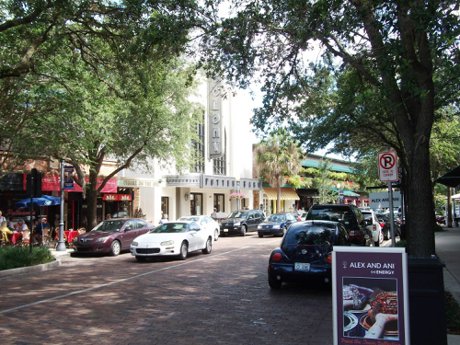
If Winter Park has a living room, it's Park Avenue. Locals call it "Little Europe" — a walkable stretch of independent boutiques, sidewalk cafés, wine rooms, and fine dining beside the green of Central Park. The Downtown Winter Park Historic District here joined the National Register of Historic Places in 2011. Our Winter Park & Park Avenue restaurants guide covers the dining; our Park Avenue guide has the full walking-and-shopping rundown.
Two cultural anchors give the Avenue its weight. The Charles Hosmer Morse Museum, founded in 1942, holds the world's most comprehensive collection of Louis Comfort Tiffany works — including the chapel he designed for the 1893 World's Columbian Exposition (admission is free on Friday evenings, November through April). And Central Park, an 11-acre green deeded by Charles Hosmer Morse, hosts the Saturday-morning Winter Park Farmers' Market at the old depot and, every March, the Winter Park Sidewalk Art Festival — the 67th runs March 20–22, 2026, has been a fixture since 1960, and draws an estimated 250,000 people.
Life on the Water: The Chain of Lakes
You can't understand Winter Park without its lakes. The Winter Park Chain of Lakes — linked by narrow, jungle-canopied canals — is the backdrop for some of Central Florida's most coveted real estate. The best way to see it is the Winter Park Scenic Boat Tour, running since 1938: six 18-passenger pontoon boats offer hour-long cruises through three lakes and two hand-dug canals, gliding past Rollins, lakefront estates, and the occasional sunbathing alligator.
Here's the thing: the lakes aren't just scenery, they're a sorting mechanism. If you've wondered why two homes a few blocks apart can differ by a million dollars, the answer is usually water.
The Rollins Effect
A respected liberal-arts college built into the town center changes how a place feels, and Winter Park is proof. Rollins brings a steady current of lectures, gallery shows, theater (the historic Annie Russell Theatre is on campus), and the long-running Bach Festival Society concerts — and it keeps the town walkable. Our Rollins College guide covers why the college is such a big part of the area's cultural punch.
Let's Talk Money: What Winter Park Actually Costs
Straight talk: Winter Park is expensive. Depending on the source and the area, median sale prices generally run from the high $400,000s into the low $600,000s — while the prestige core near Park Avenue and the lakes routinely tops $1 million, with lakefront estates well into the multimillions. For context, the broader Orlando metro median is around $395,000.
The honest read: there's no "cheap" Winter Park, but there is a range. Condos, townhomes, and single-family homes east of U.S. 17-92 (toward the 32792 zip) tend to hold the more attainable inventory; the closer you get to Park Avenue and the water, the steeper it climbs.
The Full Picture: Honest Pros and Cons
An honest guide includes the complicated parts. Hannibal Square, on the west side, was historically home to Winter Park's Black community — many of them the laborers who built the resort town. In 1893, influential residents pushed through a de-annexation that cut much of the west side out of the city limits until a new charter restored it decades later. Today it's been largely redeveloped into a dining and shopping district, bringing investment and, with it, the familiar tensions of gentrification and displacement. That's a real, ongoing part of the town's story, not a footnote.
The practical scorecard:
The Pros:
- Genuine walkability and a real town center — rare in Central Florida
- Mature tree canopy, brick streets, and lake views by design
- World-class arts and culture for its size (Morse, Rollins, the festivals)
- SunRail, Amtrak, and a short hop to downtown Orlando
- Strong, durable property values that hold up over time
The Cons:
- Expensive across the board, and steeply so near the core
- Older housing stock often means renovation or teardown-and-rebuild costs
- Park Avenue parking and festival-weekend traffic
- Smaller lots in the historic core if you want a sprawling yard
Getting Around
Connectivity is underrated here. A SunRail commuter station and an Amtrak stop share the historic depot off Park Avenue, so you can train into downtown without touching I-4. By car, downtown is about six miles south, usually 15 to 20 minutes. You're also near neighbors worth knowing — the planned-community charm of Baldwin Park to the south (our Downtown Baldwin Park guide), the museums and lakes of Maitland to the north (the Maitland Art & History Museum), and the energy of Downtown Orlando. For healthcare, the AdventHealth Winter Park campus keeps a full-service hospital close — see our AdventHealth hospital system guide.
What the Neighbors Know
Winter Park isn't trying to be the next master-planned suburb, and that's the point. It's a 140-year-old idea about how a town should feel — shaded, walkable, cultured, built beside the water — that has aged remarkably well. The neighbors will tell you the magic is the everyday version: a Saturday at the farmers' market, a boat ride at golden hour, a free Friday night at the Morse, a slow walk down Park Avenue under the oaks.
They'll also tell you it costs to be here, and that the charm comes with a complicated history worth understanding. If that mix sounds right — and your budget agrees — few places in Central Florida deliver this much character per square mile. 🌳
For events and visitor details, visit the official City of Winter Park website.
Thinking about calling Winter Park home? Browse our Winter Park homes for sale page, or contact us for honest, local relocation advice tailored to your budget and must-haves!