Apopka-Vineland Road & the Downtown Windermere Roundabouts: How a 2004 Public Works Project Transformed Traffic
Two very different roads, one traffic-calming strategy: how Windermere handles cut-through commuters on the Butler Chain isthmus.
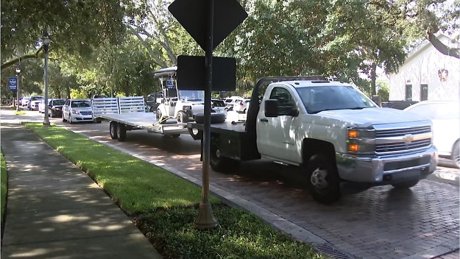
In 2004, the Town of Windermere installed two roundabouts on Main Street — at 5th Avenue and 6th Avenue, roughly 475 feet apart — as the largest public works project in the town's history. A third roundabout was completed in August 2010 at Park Avenue and Maguire Road. Apopka-Vineland Road (CR 435) runs east of downtown Windermere, not through it, and signs along that corridor warn heavy vehicles to stay out of the historic core. Together, the Main Street roundabouts and the Apopka-Vineland bypass form Windermere's two-pronged traffic strategy: slow what enters town, route the rest around it. Main Street carried 18,362 vehicles per day north of 6th Avenue in 2003 — the data point that justified the project.
If you've driven through downtown Windermere, you've noticed the place runs on roundabouts instead of stoplights. And if you've been told those roundabouts are on Apopka-Vineland Road — that's a common mix-up, and it's wrong. Windermere has two separate traffic stories happening at once on two different roads, and the town's reputation for handling commuter volume depends on both.
First, the Geography Problem
Windermere sits on a narrow isthmus in the Butler Chain of Lakes — Lake Down to the east, Lake Butler to the west, Wauseon Bay north, Lake Bessie south. If you want to drive across the chain, options are limited: the next crossing south is 7.5 miles away at Lake Buena Vista, and the next crossing north is at Gotha, about 2.25 miles up. Otherwise you're cutting through the middle of a town with Town Hall, a 100-year-old library, and a weekly farmers market sitting on its only paved through-street. That through-street is Main Street, and that's where the roundabouts are.
The 2004 Roundabouts: Main Street, Not Apopka-Vineland
Before 2004, downtown Windermere had four-way stops at Main and 5th, Main and 6th, and Main and 12th. The traffic counts the town used to justify the project were brutal for a place this small: 2003 Average Daily Traffic figures were 18,362 vehicles per day on Main Street north of 6th Avenue, 9,484 south of 6th, and 17,197 on 6th Avenue at the east entrance. Most of those vehicles weren't stopping in town — they were commuters using Main Street as a shortcut between the Horizon West side and the Conroy-Windermere corridor toward I-4 and downtown Orlando.
In 2004, the town replaced the 5th-and-Main and 6th-and-Main four-way stops with two roundabouts roughly 475 feet apart, and described it as the largest public works project in its history. The historic stretch of Main Street between 7th and 5th was repaved in brick the same year. A third roundabout went in much later — completed in August 2010 at Park Avenue and Maguire Road, the intersection at Windermere Elementary School. When locals say "the Windermere roundabouts," they usually mean the two from 2004.
Did It Work? The Honest Answer
Mostly yes, with caveats. The roundabouts kept Main Street moving without the stop-and-go pattern of four-way stops, and at lower speeds — which is the whole point in a downtown where Town Hall, the library, and the Friday farmers market are all within a block of the pavement. They also forced behavior change: drivers cutting through Windermere now have to slow to roughly 15 mph and yield, which is enough friction that some commuters reroute to perimeter roads. That's the strategy.
The caveats are real. Rush-hour volumes on Main Street are still significant, and the town has continued pushing for more roundabouts at Chase & Main and Maguire & Windermere Road, plus an upgrade to the existing 6th-and-Main circle. The 2004 project didn't solve everything; it gave downtown a way to absorb commuter volume without becoming a four-way-stop nightmare.
Now, the Apopka-Vineland Road Half of the Story
Here's where most articles get this wrong. Apopka-Vineland Road does not run through downtown Windermere. It runs east of the town along the eastern shore of the Butler Chain, designated as County Road 435 (and unsigned in most places).
South Apopka-Vineland Road eventually connects down at Lake Buena Vista, where it meets Winter Garden-Vineland Road (CR 535) and I-4. Heading north, it threads between Windermere and the Dr. Phillips area, then on toward Ocoee and Apopka. It's the perimeter road that lets through-traffic skip Windermere's historic core entirely. Drive Apopka-Vineland near the eastern town line and you'll see signs warning heavy vehicles to stay off Main Street — those signs are the second half of Windermere's strategy: route through-traffic around the perimeter, slow whatever still cuts through with the roundabouts.
How the Two Roads Work Together
The whole grid only makes sense as a system:
- Main Street + the 2004 roundabouts — the slow lane through the historic core, sized for local traffic, school traffic, and commuters who don't have a faster alternative.
- Apopka-Vineland Road (CR 435) — the fast bypass on the east side of the Butler Chain for trucks and through-commuters.
- Conroy-Windermere Road — 6th Avenue inside town becomes Conroy-Windermere outside, heading east toward The Grove at Isleworth, the Mall at Millenia corridor, and I-4.
- CR 535 (Winter Garden-Vineland Road) — the southern feeder toward Disney and the I-4 / Lake Buena Vista interchange.
- SR 429 / Western Beltway — the regional toll-road bypass for long-distance commuters.
For a deeper look at any of these corridors, our Main Street history, Conroy-Windermere Road guide, CR 535 to Disney guide, and SR 429 toll-road guide each cover one piece.
Why This Matters If You're Buying in Windermere
If you're house-hunting in the 34786 ZIP code, the road grid affects daily life more than most buyers realize. Living near Main Street (Windermere Town, Windermere Downs, Magnolia Park) puts you walking distance to Town Square and the Friday farmers market — the roundabouts are why you can actually walk it without dodging speeding cars, though morning and afternoon commuter volume is real during the school year. Living off Conroy-Windermere or near The Grove at Isleworth gives you fast access east to Restaurant Row, Mall at Millenia, and I-4, with Apopka-Vineland as a perimeter shortcut. And if you're in Summerport, Lakeside, or Lakes of Windermere on the south/southwest side, your daily roads are CR 535 and SR 429 — you'll see the roundabouts only when you head to Town Square for an event.
For a full breakdown of drive times from each area, see our Windermere commuting guide.
What the Locals Know
Windermere's traffic philosophy is genuinely unusual for Central Florida. Most small towns out here either sprawl into stroad-style four-lane corridors or capitulate to commuter cut-through. Windermere did neither. The 2004 roundabouts on Main Street, the Apopka-Vineland Road perimeter route, and the heavy-vehicle restrictions are pieces of one coherent strategy: preserve the village, route the rest around it. The result is what you see when you visit — a downtown where you can walk between Town Hall, the library, and the Friday farmers market without playing Frogger.
The roundabouts didn't fix everything, and the town is still pushing for more. But for a public works project that wrapped 22 years ago, they're still doing exactly what they were designed to do. And the next time someone tells you the roundabouts are on Apopka-Vineland Road, you'll know better — Apopka-Vineland is the road that makes the roundabouts work, by carrying everyone who shouldn't be on Main Street in the first place.
For the latest on proposed traffic improvements and town transportation projects, visit the Town of Windermere Traffic page.
Thinking about a home in Windermere and want to know how the road grid will affect your specific commute? Browse our Windermere homes for sale or contact us for a neighborhood-by-neighborhood walkthrough of drive times, school zones, and which subdivisions are inside vs. outside the roundabout zone.