The 408 Expressway: Orlando's East-West Backbone
What every Central Florida commuter should know about SR 408, the Spessard L. Holland East-West Expressway
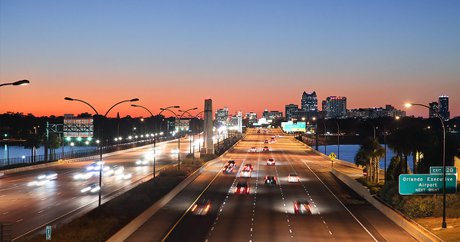
SR 408, officially the Spessard L. Holland East-West Expressway, is a 22-mile toll road running east-west through Orlando, Florida. It connects Florida's Turnpike in west Orange County near Ocoee to SR 50 (Colonial Drive) near the University of Central Florida, crossing directly through downtown Orlando. The road opened in 1973 and is operated by the Central Florida Expressway Authority (CFX), except for its westernmost mile, which belongs to Florida's Turnpike Enterprise. At peak, more than 164,000 vehicles a day use the 408 through downtown, making it the busiest road in the CFX network. Tolls are fully cashless, paid by E-PASS transponder or by a mailed Pay By Plate invoice.
If you're moving to Central Florida, you'll meet the 408 fast — probably on your first drive into Downtown Orlando. It's the road locals just call "the 408," and it's the spine that holds the metro's east-west traffic together. Officially, it's the Spessard L. Holland East-West Expressway, but nobody says that out loud.
Here's the thing: in a city stitched together by toll roads, the 408 is the one you'll use most. It runs right through the heart of Orlando, connects to nearly every other expressway, and shaves serious time off the congested alternative. Whether you're commuting downtown or just figuring out how Orlando is wired, this is the road to understand first — so let's break down what it is, what it costs, and how it shapes daily life here.
What Exactly Is the 408?
SR 408 is a 22-mile, limited-access toll road that runs east to west across Orange County. The western end ties into Florida's Turnpike out in west Orange County near Ocoee and Gotha, and the eastern end drops you onto SR 50 (Colonial Drive) just past Alafaya Trail, near the University of Central Florida.
In between, the 408 threads through Pine Hills, past the MetroWest area at the Kirkman Road exit, across Interstate 4 just southwest of downtown, and on through east Orlando. It's run by the Central Florida Expressway Authority (CFX) — all but the westernmost mile, which Florida's Turnpike Enterprise owns as its connector. And it's busy: more than 164,000 vehicles a day roll through the downtown stretch at peak, which makes the 408 the single busiest road in CFX's 125-mile network.
A Quick History (For Your Next Trivia Night)
The 408 opened on October 26, 1973, as a project of the old Orlando-Orange County Expressway Authority — the agency that eventually became CFX. The original road was a modest 13-mile bypass meant to relieve Colonial Drive; a major eastern extension in the late 1980s pushed it out toward Alafaya and UCF, giving us today's full 22-mile route.
The name honors Spessard L. Holland, Florida's 28th governor, a U.S. senator until 1971, and a decorated World War I aviator. So yes — the road you grumble about in rush hour is named after a genuine Florida heavyweight.
Why Should Orlando Residents Care?
Because the 408 is your shortcut. It runs parallel to SR 50 (Colonial Drive), the free east-west arterial that carries up to 45,000 vehicles a day in spots, choked with traffic lights and stop-and-go misery. The 408 has none of that — no signals, no cross streets. For most east-west trips it's dramatically faster, which is exactly why people pay the toll.
It's also the connector that links everything else. From the 408 you can jump onto I-4 for the theme parks and Tampa, the SR 429 Western Beltway toward the western suburbs, the SR 417 GreeneWay on the east side, or the SR 528 Beachline toward the airport and coast. For a feel for how these roads place the metro's neighborhoods, our geography of Orlando guide maps out where the good commutes actually are.
It even runs right past Orlando Executive Airport near Lake Underhill, where CFX dressed up the bridge with decorative towers as a "gateway" into the city. And if you commute downtown, the 408 parallels the SunRail corridor — a car-free option for the same trip.
The Toll Question: What It Really Costs
Let's be real — the 408 isn't free, and the cost is the part newcomers get wrong most often. Here's how it works in 2026.
First, the big change: CFX went fully cashless at the end of 2025. The coin baskets and booths are gone. You now pay one of two ways — automatically with an E-PASS (or compatible SunPass/E-ZPass) transponder, or by Pay By Plate, where a camera reads your license plate and CFX mails the registered owner an invoice. The catch: E-PASS rates run about 50% lower than Pay By Plate for the same trip.
For a typical downtown commute crossing two or three toll plazas, expect roughly $2 to $4 a day with E-PASS, or roughly $4 to $8 a day with Pay By Plate. Frequent E-PASS users can earn volume discounts of up to 25% on top of that. CFX last raised rates on July 1, 2025, and under its current policy it adjusts tolls a little each year, so treat those figures as ballpark — the official CFX toll calculator has the exact current numbers.
Bottom line for newcomers and renters: get an E-PASS before you start commuting. Drive a rental or skip the transponder, and those Pay By Plate invoices add up fast.
The Real Deal: Pros and Cons
The Pros:
- By far the fastest east-west route across Orlando — no traffic lights, no cross streets
- Connects to every major expressway: I-4, SR 417, SR 429, SR 528, and Florida's Turnpike
- Cashless gantries mean you never slow down or stop to pay
- Direct access to downtown, the Kia Center, Camping World Stadium, and Orlando Executive Airport
- A genuine alternative to the daily grind of Colonial Drive
The Cons:
- It's a toll road, and daily costs add up — especially without an E-PASS
- Pay By Plate rates are roughly double, which stings tourists and rental drivers
- Tolls tick up most years under CFX's annual adjustment policy
- The I-4 interchange still backs up during peak rush hour
Our Take:
If you're choosing where to live around the metro, factor the 408 into the math. A home that looks cheaper but adds two toll plazas to every commute isn't always the bargain it seems, while one with easy 408 access can make a slightly farther neighborhood feel a lot closer to work.
Driving the 408: Local Tips
A few things the neighbors figure out quickly. The downtown stretch and the I-4 interchange are the chokepoints — shift your commute even 20 minutes off peak and you'll feel it. On the far west end near Ocoee, the road also puts West Oaks Mall and the area's big-box retail within easy reach — see our comprehensive Ocoee shopping guide for what's out there.
One more newcomer note: don't confuse the 408 with I-4. They cross just southwest of downtown but do very different jobs. I-4 is the free interstate running northeast-southwest toward the parks and Tampa; the 408 is the toll road running east-west. Mix them up and you'll end up at SeaWorld when you meant to go to UCF.
What the Neighbors Know
The 408 isn't glamorous, but it's the most useful road in Orlando — the one that quietly makes the rest of the metro reachable. Locals don't think twice about the toll because the time it saves over Colonial Drive is worth it almost every day.
For anyone relocating here, understanding the 408 is really about understanding how Orlando fits together: a downtown core ringed by expressways, with neighborhoods that live or die by their access to them. Get an E-PASS, learn which exits get you home, and the 408 stops being a mystery and starts being your daily shortcut. 🚗
For current routes, toll rates, and project updates, visit the official SR 408 page at the Central Florida Expressway Authority.
Trying to figure out which Orlando neighborhoods give you the best access to the 408 and the rest of Central Florida's expressways? Explore homes near the corridor in Downtown Orlando and Ocoee, or contact us for personalized relocation advice!